
8 ways to know if you have a job or own a business


jobs-300x152The ultimate test of your business can be found in a simple question: would someone want to buy your company?

Whether you want to sell next year or a decade from now, you must be building an asset someone would buy – otherwise, you have a job, not a business.

Here are eight ways to ensure you are building a company, not just doing a job:

  1. A job requires that you show up at work to make money, whereas a company generates turnover whether you are there or not.
  2. If your company is so reliant on a single customer that they can dictate how you deliver your product or service, your company is more like a job than a valuable business.
  3. A job is a place where your personal reputation impacts your results, whereas a company is a place where the brand is more important than the personality of the founder(s).
  4. A job requires you to use your personal experience and expertise to get a result, whereas a company is a place where a process – not a person – consistently produces a desirable result.
  5. In a job, you get fired for taking too much vacation, whereas if you own a company, the more vacation you can take without impacting your company’s performance, the more valuable your business will be.
  6. In a job, the harder you work, the more money you earn. In a company, the smarter you work, the more money you earn.
  7. In a job, you solve the problems. If you own a company, your employees solve the problems.
  8. If the majority of your customers know your mobile phone number, it’s likely you have a job, not a company.

If you’re not sure whether you have a job or own a business, it’s time to get your Sellability Score. Whether you want to sell now or in a decade, the Sellability Score assessment allows you to see your business as a buyer would see it, and to identify how you perform on each of the eight key drivers of sellability. The questionnaire takes about 13 minutes to complete, and after you’re finished you’ll get a customized 27-page report outlining how you performed and where you could improve the value and sellability of your company. Get your score now  http://krugerservices.com.au/services/sellability-sco/

Prevention is better than cure


To grow a valuable business – one you can sell – you need to set up your company so that it is no longer reliant on you.

This can be easier said than done, especially when, like a PR consultant or plumber, what you are selling is your expertise.

To scale up a knowledge-based business, you first have to figure out how to impart your Sellfranchise-300x198knowledge to your employees, so that they can deliver the goods. However it can be difficult to condense years of school and on-the-job learning into a few weeks of employee training. The more specialised your knowledge, the harder it is to hand over work to juniors.

The key to scaling up a service business can often be found by offering the service that prevents customers from having to call you in the first place. You have to shift from selling the cure to selling the prevention.

Fixing what is broken is typically a hard task to teach; however, preventing things from breaking in the first place can be a far easier task to train others to do.

For example, it takes years for a dentist to acquire the education and experience to successfully complete a root canal, but it’s relatively easy to train a hygienist to perform a regularly scheduled cleaning.

It’s almost effortless for an estate agency manager to hire someone to clean the gutters once a month, but repairing the flooded basement caused by the clogged gutters can be quite complex.

For a master car mechanic, overhauling an engine that has seized up takes years of training, but preventing the problem by regularly changing a customer’s oil is something a high school student can be taught to do.

For an IT services company, restoring a customer’s network after a virus has invaded often takes the know-how of the boss, but preventing the virus by installing and monitoring the latest software patches is something a junior can easily be trained to do.

When you’re selling your expertise, it can be tough to hire a team to do the work for you. As ironic as it sounds, sometimes the key to getting out of doing the work is to offer a preventive service, which not only maintains your business income, but also eliminates the need for someone to call you in the first place.

Four ways to protect your turf

Wwarren-buffett-has-some-incredibly-specific-advice-for-where-the-average-investor-should-invest-300x224arren Buffett famously invests in businesses that have what he calls a protective ‘moat’ around them – one that inoculates them from competition and allows them to control their pricing.
Big companies lock out their competitors by out-slugging them in capital infrastructure investments, but smaller businesses have to be smarter about how they defend their turf. Here are four ways to deepen and widen the protective moat around your business:

Get certified

Is there a certification program that you could take to differentiate your business? For example, a Canadian company that disposes of radioactive waste decided to get licensed by the Canadian Nuclear Safety Commission.  It was a lot of paperwork and training, but the certification process acts as a barrier against other people jumping into the market and competing.

Is there a certification you could get that would make it more difficult for others to compete with you?

Create an army of defenders

Ecstatic customers act as defenders against other competitors entering your market, a factor that has enabled companies like Trader Joe’s in the US to defend their market share in the bourgeois bohemian (bobo) market, despite a crowded market of stores hawking groceries

Get your customers to integrate

Is there a way you can get your customers to integrate your product or service into their operations?

The basic switching costs of Customer Relationship Management (CRM) software are virtually nil.  Everyone from 37signals to Salesforce.com will give you a free trial to test their wares.

The real expenses associated with changing CRM software only come when a business starts to customize the software and integrate it into the way they work. Once a sales manager has trained his salespeople in creating a weekly sales funnel in a CRM platform, try to convince him to switch software.

Can you offer your customers training in how to use what you sell to make your company stickier?

Become a verb

Think back to the last time you looked for a recipe. You probably ‘googled’ it.  Part of Google’s competitive shield is that the company name has become a verb. Now every time someone refers to searching for something online, it reinforces the competitive position of a single company.

Is there a way you could control the vocabulary people use to refer to your category or specialty?

Widening your protective moat triggers a virtuous cycle: differentiation leads to having control over your pricing, which allows for healthier margins, which in turn lead to greater profitability and the cash to further differentiate your offering.

If you’re wondering how differentiated your businesses is, take the 13-minute Sellability Score questionnaire and find out….  


Why fire trucks always back in

Have you ever noticed that fire trucks always back into the fire hall? ————————————————————————————-

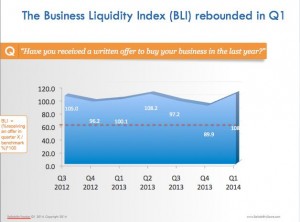
Why don’t they just pull into their parking spot snout-forward like the rest of us? Backing in at the end of a shift saves them time when they have to get to a fire. They back in to be ready; whether the call comes in 5 minutes or 5 days, they are prepared to pull out as quickly as possible. Like the firemen, you, as a business owner, need to be ready when you get the call from someone who wants to buy your business. And these days, owners are getting that call more often. According to the latest Sellability Tracker report, the proportion of business owners who received an offer to buy their company in the quarter ending March 31, 2014 was up considerably from Q4 2013. Roughly 12% of business owners using The Sellability Score last quarter had recently received an offer to buy their business.

Business-Liquidity-300x222

The proportion of owners getting an offer is an important statistic because it measures one half of the equation of a business sale. For a transaction to take place, there must be both a willing seller and a willing buyer. Companies are becoming more acquisitive because they have access to more cash than they know what to do with. Interest rates are next to nothing, and after the liquidity crisis of 2008, companies have been socking away profits on their balance sheet for a rainy day. This increase in acquisitiveness among buyers has important implications for you as a business owner. Chief among them is that you need to have a sellable asset when opportunity strikes. Statistically speaking, the two most common reasons you are likely to sell your business are:

  1. A health scare;
  2. An unsolicited offer to buy your business.

As unsolicited offers increase, so too does the need for you to be ready if an opportunity comes your way. Unlike when the owner is in control of when he/she decides to list a property, the hallmark of an unsolicited offer is the fact that the owner doesn’t’ know when it is going happen; which means you need to operate your business as if an offer were always around the corner. Companies that are sloppily put together with shoddy bookkeeping or too much customer concentration, or that are run by a Hub & Spoke manager, will end up being passed over for turnkey operations. The time is now for you to get your company ready to showcase when opportunity comes knocking.

Business Conditions Survey

NSW Business Chamber released the following business condition survey.

March 2014 Key Findings

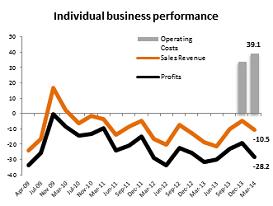
  • GraphBusinesses became more negative about their own performance, compared with December 2013.

  • Profit and sales revenue experienced falls, and there were increasing concerns about the rising costs of doing business.
  • Staff numbers and capital investment also fell significantly this quarter.
  • Job Ads figures remained steady.
  • A quarter of businesses surveyed reported that they have trouble accessing suitably skilled staff.
  • Skills and professions in demand were Sales and marketing, Customer service and retail, Chefs and hospitality workers, and IT related skills such as programming and web development.
  • The Financial and insurance services sector was best performing industry this quarter, whilst the construction sector recorded poor results across the state.


Full survey available on the NSW Business Chambers website

Growth vs. Value: not all turnover is created equally

When you look ahead, will your growth come from selling more to your existing customers or finding new customers for your existing products and services?

The answer may have a profound impact on the value of your business.

Tagrowth_stocks~001ke a look at the research coming from a recent analysis of owners who completed their Sellability Score questionnaire. We looked at 5,364 businesses and found that the average company that had received an overture from an acquirer was offered 3.5 times their pre-tax profit.  When we isolated just the businesses that had a historical growth rate of 20 per cent or greater, the multiple offered improved to 4.3 times pre-tax profit, or about 20 per cent more than their slower growth counterparts.

However, the real bump in multiple came when we isolated just those companies that claim to have a unique product or service for which they have a virtual monopoly. The niche companies enjoyed average offers of 5.4 times pre-tax profit, or roughly 50 per cent more than the average companies, and fully 20 per cent more than the fastest growth companies.

Nurture your niche

Chasing “bad” turnover by offering a wide array of products and services is common among growth companies. The easiest way to grow is to sell more things to your existing customers, so you just keep adding adjacent product and service lines. But when a strategic acquirer buys your business, they are buying something they cannot easily replicate on their own.

A large company will place less value on the turnover derived from products and services that you have in common. They will argue that their economies of scale put them in a better position to sell the things that you both offer today.

Likewise, they will pay the largest premium to get access to a new product or service they can sell to their customers. Big, mature companies have customers and systems, but they sometimes lack innovation; and many choose a strategy of acquisition as a way to buy their innovation.

Focusing on your niche is one of many areas where the long-term value of your business is at odds with short-term profit. For example, if you wanted to maximise your short-term profit, you might avoid investing in new technology or hiring a head of sales, arguing that both investments would hinder short-term profit. The truly valuable company finds a way to deliver profit in the short term while simultaneously focusing their strategy on what drives up the value of the business.

You can get your own Sellability Score, and see how you compare on the eight key drivers of sellability, by taking our 13-minute survey here

5 “strategic” ways to sell your company

ways to sell your companyDid you see the news that Facebook has recently acquired Internet messaging service WhatsApp for USD19 billion? It represents the largest-ever acquisition of an Internet company in history.

WhatsApp is a pearl for sure. The messaging service allows users to avoid text-messaging charges by moving texts across the Internet instead of the mobile phone carrier networks. This can save people who travel, or who live in emerging markets, hundreds of dollars a year, which is why WhatsApp is adding one million new users per day.

At the time of the acquisition in February 2014, WhatsApp had acquired some 450 million users. Their business model is to charge a subscription of $1 per year after their first full year of service. Even if all 450 million WhatsApp users were already paying, that is still less than half a billion in turnover. Why would Facebook acquire WhatsApp for a number that is somewhere north of 40 times turnover?

Nobody knows for sure what is in Mark Zuckerberg’s head, but we can only assume that at least part of the opportunity Facebook sees is the opportunity to sell more Facebook ads because of the information they glean from WhatsApp users. Global advertising giant Publicis estimates 2013 online advertising spending in the US alone to be around USD500 billion. Presumably Facebook believes they can get a larger chunk of the global online ad buy because they know more about its users by owning WhatsApp.

And therein lies the definition of a strategic acquisition. Most acquisitions run a predictable pattern of industry norms, but a strategic can pay a significant premium for your business because they are looking at your business for what it is worth in their hands. Rather than forecasting out your future profits and estimating what that cash is worth in today’s dollars, a strategic is calculating the economic benefit of grafting your business onto theirs.

There can be many strategic reasons why a big company might want to buy yours. Here are a few to consider:

1. To control their supply chain

In 2011, Starbucks announced it had acquired Evolution Fresh, one of their providers of juice drinks, for USD30 million. Now Starbucks is no longer beholden to one of its suppliers.

2. To give their sales people something else in their briefcase

Also in 2011, AOL announced the acquisition of The Huffington Post for USD315 million, even though HuffPo had just turned its first modest profit on paper. AOL wanted to give its advertising sales people more inventory to sell and HuffPo had 26 million unique visitors a month.

3. To make their cash cow product look sexier

Microsoft bought Skype for USD8.5 billion even though Skype was losing money. The good folks in Redmond must have assumed they could sell more Windows, Office and Xbox by integrating Skype into everything they already sell.

4. To enter a new geographic market

Herman Miller paid USD50 million to acquire China’s POSH Office Systems in order to get a beachhead into the world’s fastest growing market for office furniture.

5. To get a hold of your employees

Facebook reportedly acquired Internet start-up Hot Potato for USD10 million largely to get hold of the talented developers working at the company.

Most acquisitions are done for rational reasons where an acquirer agrees to pay today for the rights to your future stream of cash. You may, however, be able to get a significant premium for your company if you can figure out how much it is worth in someone else’s hands.

Curious to see what your business is worth and how you might improve its value to both strategic and financial acquirers?  Complete the Sellability Score questionnaire today and we’ll send you a 27-page custom report complete with your score on the eight key drivers of Sellability. Take the test now: